To seamlessly hide messy cords behind your TV stand, you can use several effective DIY methods, including bundling cables with sleeves or ties, utilizing adhesive cable clips and raceways, strategically placing furniture, or opting for an in-wall cable management system. These solutions transform your entertainment area into a harmonious and visually appealing focal point, reducing clutter and enhancing safety.
The Clutter Conundrum: Why Hide Your TV Cords?
Beyond the obvious aesthetic improvements, managing your television cords offers several compelling benefits. A neatly organized setup minimizes the visual noise in your living space, contributing to a calmer and more sophisticated ambiance. It also significantly reduces dust accumulation, making cleaning easier and potentially prolonging the life of your electronics by preventing overheating caused by blocked vents. Most importantly, it enhances safety by eliminating tripping hazards, especially crucial in homes with children or pets. A well-managed cord system protects your valuable equipment from accidental disconnections and damage, giving you peace of mind that your entertainment hub is both functional and safe.
Essential Tools for a Tidy Entertainment Hub
Before you embark on your cord-hiding mission, gathering the right tools will make the process smoother and more effective. Many of these items are inexpensive and readily available, ensuring your DIY project is both budget-friendly and achievable. For explore our tv stands reviews on this site.
- Cable Ties (Zip Ties or Reusable Velcro Straps): Indispensable for bundling multiple wires together. Velcro straps offer flexibility for future changes.
- Cable Management Sleeves/Cord Hiders: These flexible tubes or wraps enclose several cables, consolidating them into a single, cleaner bundle.
- Adhesive Cable Clips/Hooks: Ideal for securing individual cables or bundled wires along the back of furniture, walls, or TV stands, preventing them from dangling.
- Cable Raceways/Cord Covers: Surface-mounted channels that attach to walls or furniture, completely encasing wires. Many are paintable to blend with your décor.
- Surge-Protected Power Strip: Consolidates multiple plugs into one unit, protecting your electronics from power surges, and often making it easier to manage power cords.
- Drill (for In-Wall Solutions): Necessary if you plan a more permanent in-wall cable management system for a wall-mounted TV.
- Measuring Tape & Pencil: For planning routes and marking installation spots.
- Scissors/Wire Cutters: For trimming cable ties or raceways.
- Labels (Optional but Recommended): To identify individual cables, simplifying future troubleshooting or reconfigurations.
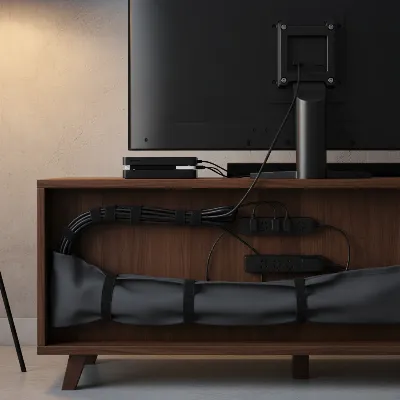 A modern living room with a TV stand, all cables neatly organized behind it with cable ties and sleeves, showcasing a clutter-free aesthetic.
DIY Methods to Master TV Cord Concealment
Transforming your messy cord situation into an organized masterpiece doesn’t require professional help. With a few simple techniques and readily available tools, you can achieve a clean, streamlined look.
Embrace Cable Management Sleeves and Ties
|
Our Picks for the Best TV Stand in 2026
As an Amazon Associate I earn from qualifying purchases.
|
||
| Num | Product | Action |
|---|---|---|
| 1 | Furinno Sully 3-Tier Stand for TV up to 40, Espresso/Black |

|
| 2 | WALI Floor TV Stand with Power Outlet, Tall TV Stand Mount for 32-75 inch TV up to 110 lbs, Swivel and Height Adjustable TV Stands with Wood Base for Bedroom, Office(TVDVD-7P), Black |
|
| 3 | HOOBRO TV Stand with Power Outlets to 65 Inches, TV Console Table with Open Storage Shelves, Industrial Media Entertainment Center for Living Room Bedroom, Rustic Brown and Black BF40DS01 |
|
| 4 | TV Stand for TVs up to 55", Entertainment Center with 2 Fabric Drawer, Media Console with Shelves, Television Stands for Living Room, Bedroom, Black DS02BB |
|
| 5 | YGEOMER Entertainment Center for Up to 55 Inch TVs, TV Stand with Power Outlet and Open Storage Shelves, TV Media Console Table for Living Room and Bedroom, Black |
|
| 6 | HOOBRO TV Stand with Charging Station to 55 Inches, LED Entertainment Center, Media TV Console Table with Open Storage Shelving for Living Room, Bedroom, Black BB122UDDS01 |
|
| 7 | PERLESMITH Universal Swivel TV Stand for 24-60 inch TVs up to 99 lbs, 12 Height Adjustable Table Top TV Stand, TV Base Stand with Tempered Glass Base, Max VESA 400x400mm, PSTVS33 |
|
| 8 | 23 Inch to 50 Inch Floor Small Corner TV Stand with Storage Shelves for Living Room Bedroom, Universal Floor Television Stands with Mount, Rustic Brown Corner TV Table Desk Shelf for Small Space |
|
| 9 | HOOBRO LED TV Stand with Power Outlets to 65 inch TV, Gaming Entertainment Center with Glass Shelves and Large Drawer, Modern Media TV Console Table for Living Room Bedroom, White WT14UDDS01 |
|
| 10 | Furologee TV Stand for TVs up to 55 Inch, Entertainment Center with Open Storage Shelves, Media Console Table with Soundbar Shelf for Living Room, Bedroom, Rustic Brown |
|
The simplest and most immediate solution for taming cable chaos is to group them together. Individual wires often look messier than a single, thicker bundle.
- Cable Sleeves: These flexible, often zippered or wrap-around sleeves, gather all your cables (HDMI, power, audio) into one neat cylinder. They come in various lengths and colors, allowing you to choose one that blends with your stand or wall. Simply open the sleeve, insert your cables, and secure it.
- Velcro Ties or Zip Ties: For an even more budget-friendly approach, use Velcro ties or zip ties to bundle wires. Group similar cables together first (e.g., all power cords, all HDMI cords) and then use ties to create a cohesive bundle. Velcro ties are particularly useful as they can be easily undone and redone if you need to add or remove a cable.
By consolidating your wires, you instantly reduce the visual clutter and make them much easier to conceal behind your TV stand or other furniture.
Utilize Cable Raceways and Cord Covers
When wires need to run along a visible surface, such as a wall or the top of your TV stand, cable raceways and cord covers provide an elegant solution.
- Surface-Mounted Raceways: These plastic channels adhere to the wall or furniture with strong adhesive. You simply place your cables inside, snap the cover shut, and the wires are completely hidden. Many raceways are paintable, allowing you to match them to your wall color for an almost invisible finish. They are available in various sizes to accommodate different numbers of cables.
- Decorative Cord Covers: For a softer, more integrated look, consider fabric cord covers that can complement your room’s aesthetic. Some are designed to mimic crown molding or blend seamlessly with baseboards.
These solutions are less invasive than in-wall options and offer easy access to cables should you need to reconfigure your setup.
Strategic Furniture Placement
Sometimes, the best hiding spot is right in plain sight—or rather, just behind it. Leveraging your existing furniture can be a highly effective way to obscure messy cords.
- Behind the TV Stand: Position your TV stand slightly away from the wall to create a narrow gap. Run all your bundled cables along the back of the stand, securing them with adhesive clips or hooks to prevent them from drooping. Ensure your power strip is also mounted to the back of the stand, keeping it off the floor.
- Other Furniture: Utilize bookshelves, cabinets, or even large floor plants to strategically block the view of any exposed wires. Arrange these items to create a visual barrier between the viewer and the cable clutter.
- Decor Items: Smaller decorative items like photo frames, sculptures, or potted plants can also serve as clever camouflages for shorter cable runs or power strips.
This method integrates seamlessly with your existing décor and requires minimal effort, making your TV setup a natural part of your room’s design.
The In-Wall Solution for a Seamless Look
For wall-mounted televisions, the ultimate solution for a truly invisible cable setup is running the wires inside the wall. This method requires a bit more DIY effort but delivers a remarkably clean and professional finish.
- In-Wall Cable Management Kits: These kits typically include all the necessary components: a power extension, low-voltage cable plates, and sometimes a drill bit. You’ll install two openings in your drywall: one directly behind your TV and another lower down, usually near an existing power outlet or your TV stand.
- Threading Cables: The kit provides a pathway (often a flexible tube or simply the open wall cavity) to thread your power and AV cables through the wall, from the top opening to the bottom. The power extension included in the kit ensures power is supplied safely.
While this approach demands more planning and basic DIY skills (and adherence to local electrical codes), the result is a sleek, wire-free wall that elevates the entire room’s aesthetic.
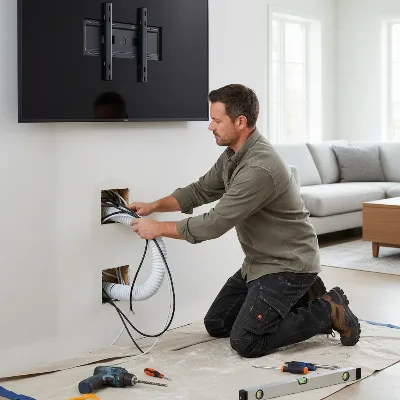 A DIYer installing an in-wall cable management kit behind a wall-mounted TV, showing neatly channeled wires through the wall for a clean, hidden look.
Leverage Integrated TV Stands and Media Consoles
Many modern TV stands and media consoles are designed with cable management in mind, offering built-in solutions that simplify the process.
- Built-in Channels and Grommets: Look for stands that feature pre-drilled holes (grommets) in the back panels or shelves, allowing cables to pass through neatly. Some designs even include internal channels to guide wires from one compartment to another.
- Enclosed Storage: Consoles with cabinet doors or drawers are excellent for hiding not only cables but also larger devices like cable boxes, gaming consoles, and routers, keeping them out of sight when not in use. This creates a cohesive, clutter-free appearance.
- Mountable Back Panels: Some TV stands come with a solid back panel where you can easily attach power strips or cable clips, ensuring all wires remain hidden behind the unit.
Investing in a TV stand with integrated cable management can be a major upgrade, providing a dedicated space for all your entertainment gear and its accompanying wires.
Clever Power Strip Management
The power strip is often the source of the most visible clutter. Managing it effectively is crucial for a tidy setup.
- Mount to Furniture: Instead of letting your power strip lie on the floor, mount it to the back of your TV stand or inside a cabinet using adhesive strips, screws, or zip ties. This keeps it off the floor and out of sight.
- Decorative Boxes: For an immediate and stylish fix, place your power strip and any excess cable length into a decorative box. Many companies sell specialized cable management boxes, but a stylish storage box or even a hollowed-out “book” can work wonders. This keeps everything contained and blends seamlessly with your décor.
Pro Tips for Optimal Cable Organization
Once you’ve implemented your chosen hiding methods, a few extra tips can help maintain a pristine and functional entertainment area.
- Label Your Cords: Use small labels (or even colored tape) to mark each end of your cables. This will save you immense frustration when you need to unplug or reconfigure a specific device.
- Separate Power and AV Cables: Whenever possible, run power cords separately from audio/video cables. This can help prevent electromagnetic interference, which might impact the quality of your signal.
- Regular Checks: Periodically check your cable management system. Wires can shift, dust can accumulate, and connections might loosen. A quick tidy-up every few months will keep things looking perfect.
- Future-Proofing: When choosing your cable management solutions, consider future additions or changes to your entertainment system. Opt for methods that allow for easy expansion or modification, such as reusable Velcro ties or raceways with removable covers.
- Only Connect What’s Necessary: Before you even begin, disconnect any devices or cables you no longer use. Less is more when it comes to cable management.
Conclusion
Taming the unruly mess of cables behind your TV stand doesn’t have to be a daunting task. By utilizing simple DIY methods like bundling with sleeves and ties, employing clever raceways, strategically placing furniture, or even undertaking an in-wall installation, you can improve your entertainment area into a streamlined, safe, and visually appealing space. A clutter-free environment not only looks better but also contributes to a sense of calm and order in your home. Take the first step today, gather your tools, and enjoy the satisfaction of a perfectly organized TV setup. What simple change will you make to start decluttering your cords?
Frequently Asked Questions
Can I hide TV wires without drilling into the wall?
Absolutely! Many effective methods exist that don’t require drilling, such as using adhesive cable clips and raceways that stick to surfaces, bundling cables with sleeves or ties, or strategically placing furniture and decorative items to conceal them.
What is the easiest DIY way to hide TV cords?
The easiest DIY method is often to bundle your cables together using Velcro ties or cable sleeves, and then secure these bundles behind your TV stand with adhesive cable clips. This immediately reduces clutter with minimal effort.
Is it safe to run power cables under a rug?
No, it is generally not safe to run power cables under rugs as they can overheat, get damaged, and pose a fire hazard. Low-voltage cables like speaker wires or Ethernet cables are safer to run under rugs, but it’s best to use a flat, durable raceway to protect them and ensure safety in low-traffic areas.
How can I hide a power strip behind my TV stand?
You can hide a power strip by mounting it directly to the back of your TV stand using adhesive strips, screws, or zip ties. Alternatively, place the power strip and any excess cabling inside a decorative cable management box.
How often should I reorganize my TV cords?
It’s a good idea to check and reorganize your TV cords every few months, or whenever you add or remove a device. Regular checks prevent dust buildup, ensure cables remain secure, and help maintain the clean look you’ve achieved.
Frequently Asked Questions
Can I hide TV wires without drilling into the wall?
Yes, you can hide TV wires without drilling. Effective methods include using adhesive cable clips and raceways that stick to surfaces, bundling cables with sleeves or ties, or strategically placing furniture and decorative items to conceal them. These options offer flexibility and ease of installation.
What is the easiest DIY way to hide TV cords?
The easiest DIY method to hide TV cords is to bundle them together using Velcro ties or cable sleeves. After bundling, secure these groups of cables behind your TV stand with adhesive cable clips. This approach immediately reduces visual clutter with minimal effort and cost.
Is it safe to run power cables under a rug?
No, it is generally not safe to run power cables under rugs. They can overheat, become damaged from foot traffic, and pose a significant fire hazard. For low-voltage cables like speaker wires, using a flat, durable raceway is recommended to protect them and ensure safety in low-traffic areas.
How can I hide a power strip behind my TV stand?
You can effectively hide a power strip by mounting it directly to the back of your TV stand using adhesive strips, screws, or zip ties. Another stylish option is to place the power strip and any excess cabling inside a decorative cable management box, blending it with your room's du00e9cor.
How often should I reorganize my TV cords?
It is a good practice to check and reorganize your TV cords every few months, or whenever you add or remove a device from your entertainment system. Regular checks help prevent dust buildup, ensure cables remain securely in place, and maintain the clean, organized look you've achieved.
How to Hide Messy Cords Behind Your TV Stand
Transform your entertainment area by concealing unsightly cables with these simple DIY methods, creating a clean and organized look.
Gather all your cables (HDMI, power, audio) and consolidate them into a single, neat cylinder using cable management sleeves. Alternatively, use reusable Velcro ties or zip ties to bundle similar cables together, such as all power cords or all HDMI cords. This instantly reduces visual clutter.
For cables running along visible surfaces like walls or the top of your TV stand, use surface-mounted raceways. These plastic channels adhere to the surface, encasing wires completely. Many raceways are paintable to match your wall color, offering an almost invisible finish.
Leverage your existing furniture to obscure cables. Position your TV stand slightly away from the wall and run bundled cables along its back, securing them with adhesive clips. You can also use bookshelves, cabinets, or large floor plants to block the view of exposed wires.
For wall-mounted televisions, consider an in-wall cable management kit. This involves installing two openings in your drywallu2014one behind the TV and one lower downu2014to thread power and AV cables through the wall cavity. This method provides a truly seamless, wire-free aesthetic.
Prevent power strips from creating clutter by mounting them to the back of your TV stand or inside a cabinet using adhesive strips, screws, or zip ties. Another option is to place the power strip and any excess cable length into a decorative cable management box, keeping it out of sight.

I really liked the suggestion about using raceways for a more permanent solution. I was hesitant to drill into the wall for an in-wall system, so the raceways were a great middle ground. It took a little longer to install than I expected, but the result is super clean and makes the whole TV area look so much more put together. No more tangled mess!
I finally tackled the mess behind my entertainment center thanks to the idea of using cable sleeves. My old setup was a disaster with wires everywhere, collecting so much dust. Now it looks so much cleaner and I don’t have to worry about my cat trying to chew on anything. Definitely a game changer for a tidy living room!
The adhesive cable clips worked okay for some of my lighter cables, but they kept falling off when I tried to use them for the thicker power cords. I ended up having to reinforce them with some stronger tape, which kind of defeats the purpose of the ‘easy’ solution. It’s better than nothing, but not perfect.
My biggest issue was always the visual noise from all the cords. I used a combination of cable ties and strategically placed my TV stand a bit closer to the wall, and it made a huge difference. It’s amazing how much calmer the room feels now without all those distracting wires. Highly recommend taking the time to organize them.